Showing posts with label Eastern Ghats. Show all posts

Monday, May 2, 2011

Roads Across Odisha-3

Roads Across Odisha-3


The Kuldhia Experience:


Dedication:

I dedicate all my travels till date to comrade late Dr. Kamla Prasad, whom I have affectionately call “Tauji” , whose spirit to travel has always somehow inspired me to reach out and explore the world around me. I also use to call him modern day “Rahul Sankrutyayan”, on 25th of March 2011, he lost his battle with cancer and his spirit became free to travel anywhere without limitations of this world. I will always remember the shear energy that he used to inject in his conversations with his shear presence and words. Tauji will always live in memories of everyone around him.

The Kuldhia wildlife Experience:
After coming back from Kunwaria wildlife sanctuary we took a good nap in Bhubaneswar, as we had to catch Jan Shatabdi express to Balasore early in the morning to reach to Kuldhia wildlife sanctuary, Balasore seems to be another Indian town stuck up in between its Indian name and it’s British Name. It was named Baleshwar in the older times, but British changed it to Balasore. I believe whatever be the name of the town in future; the taste of the Bada chaps near the railway station should remain same forever (the prize as well).
 Kuldhia is famous for its Elephants, and I till now never had an experience of coming face to face with wild elephant and I was thrilled and excited with just a thought of it.

The Kuldhia plays a vital cog in the wheel for elephant corridor in eastern India. It is connected with Simplipal and Mayubhanj forest range and serves as a transition point for wandering herds of wild elephants.  Kuldhia also boasts of around 300 native elephants, apart from the wandering population.
    
With expressways coming up in Odisha to give way for faster logistics, the elephant corridors and with them the Elephants are getting lost every day and the electrification of the forest boundaries, resulting in electrocution of elephants and young calves adding to the miseries of the giant pachyderms. And its not only the gentle giants who are getting agitated by all this, the humans are also at receiving end. When we reached the small town of Nilgiri to seek permission for entering the Kuldhia wild life sanctuary, the mood in the town was somber but filled with anger. The wandering elephants are running havoc in the nearby human settlements and local paddy farmers were out on streets let the governments know that even if a single elephant does trespassing in human territory, they will be dealt with harsh way. Readers might feel that this could be harsh step but the kind of compensation offered by government of Odisha for elephant damages is nothing but a joke. From partial damage of crop to full damage the compensation ranges from Rs. 500/- to Rs. 2000/-, it also raises a pertinent question that, is our government serious about protecting wildlife?

After receiving permission from leisurely paced Babus of the forest department, we proceeded towards our destination. As we entered the small tenements en-route to the sanctuary we observed the roads are in pathetic state in fact it seemed like a sabotaged road with pot holes depth ranging in meters. On inquiring the driver confirmed our suspicion and said that the road has been dugged up by the wood poachers so as to avoid any swift action from forest department when their men are at work.

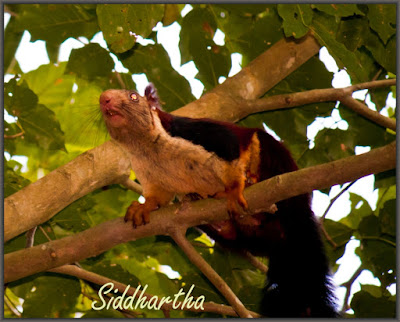
As soon as we entered the sanctuary after showing gate pass to a name sake forest guard, we saw heavy activity in canopy of trees and we left our jeep to get few glimpses of elusive Malabar Giant Squirrel. Plethora of times that we have seen the Giant squirrel in the Jungles of Odisha and Karnataka instead of Maharashtra (Giant squirrel is state animal of Maharashtra), makes me believe that making an animal state animal or national animal does not necessarily results in its conservation and is just a symbolic representation. Extinction of Tigers is a story which under production and I suppose the giant squirrels in Maharashtra are following the same story line.  

Malabar Giant Squirrel

We reached the Kuldhia forest guest house at around 11:30 AM. We were welcomed by a fully grown Peacock in the rest house walking around the circumference of rest house.  Satya straight away went for a bath and I decided to look around for a few birds. Again I could observe big nests of Giant squirrel very close by to the watch tower and soon the forest officer in the rest house Manoranjan by observing me came to me to know what I am looking at.


Peacock

Till the time Satya came out, I had already befriended Manoranjan and had shot a few good pictures of Peacock and Giant squirrels.  The food was ready by the time I took bath and it was time to  start enjoying another course of sumptuous Odiya meal.

After having our food we took a walk around the FRH and then it was time to test the comforts offered by the bed in the room. After enjoying a power nap of around 1 hour, we asked Manoranjan to accompany us for a walk in the forest. He obliged and as soon as we entered the forest we could see an entire colony of plum headed parakeets resting on the top of the tall saal and teak trees. We kept on walking till the time we reached a big rock having a lot of den like voids. Observing closely we found excretion of a carnivore with hairs and high calcium content.  We climbed up the rock to see if getting elevated helps us to uncover any wildlife, but failed to do so.

By the time we came back to the rest house we were informed by the cook named Hari Bhaina, that it is good time to sit at watch tower and wait for tuskers to come to the salt lick which lies directly in line with the watch tower. We were sitting there, as the sun was going down air was getting a cold. It was a perfect setting for a cup of Tea (chai) and biscuit. As we were enjoying our sips of hot tea, the discussions went in to snakes and their stories. As we were discussing the matter in great detail, all of a sudden Satya whiskered excitingly and asked us to look towards the salt lick. It was a young male Tusker who visited the salt lick.  We went down the watch tower, but were warned by the forest officials not to go too close as tuskers away from their herd are vulnerable and susceptible to charges on humans.

Tusker In Kuldhia

It was a perfect start of the day -1, and just before our dinner we were getting more and more indulged in to wild stories of the sanctuary. The Hari Bhaina told us that there is a small temple of Jungle deity on the fringes of rest house. The Deity is known as Budhi Thakurani. The temple is said to be ancient and when the local king use to come to Jungle to capture elephants for domestication, he used to pay tribute to the deity before starting his operation. Also the Hari Bhaina has seen elephants come regularly at the temple and   consume the Prasad offered to the deity.  We decided to pay our visit to the temple as well in the morning. After having our dinner we went for a night safari with special permission from the range office.

As we left on our jeep with Manoranjan, I was keeping a watch on right side of the road and Satya was giving surveillance on the left side. As soon as our jeep passed a small bridge on a Nallah, I observed an odd leaf on the tree and directed my torch in that direction to observe that it was a fully grown Fish Owlet sitting on the bark of the tree. It gave us patient shots and then flew away.

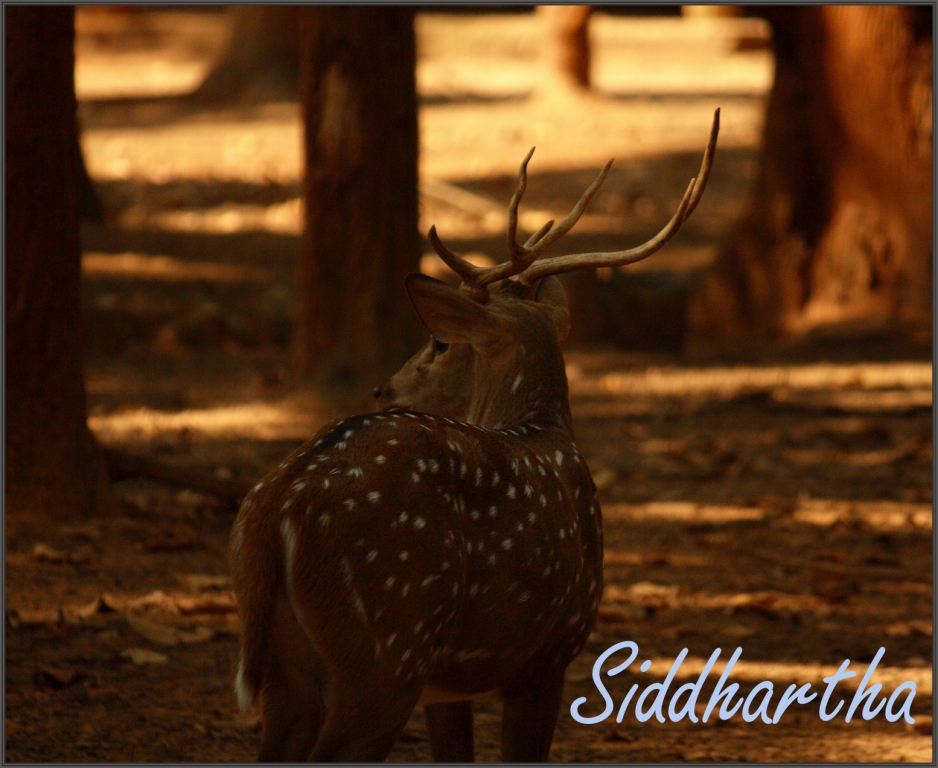
 Barking Deer


Fish Owlet

White Rumped Shama

On our course of Night Safari we also came across a barking Deer, unaware and not bothered of our presence.  We came back the rest house and were too satisfied to go to bed.
   
Before sleeping we had already chalked out the plan to go to Risia Dam early in the morning to do bird watching.
 
Early in the morning we left for the dam and were surprised to see so many birds around the dam. We could observe that Manoranjan was a quick learner and had learnt the art of bird watching very quickly and was eager to learn more.  

Oriole

Common Iora

Chestnut headed Bee Eater

Crested Bulbul


Sun Bird

It was not only birds who were more than happy to give us shots, but reptiles were also getting in line to do the same. 


Chameleons basking in Sun

We had to leave dam site a bit early as Manoranjan had to report to forest rest house to relieve one more staff.

We left for the rest house had our lunch and left the Kuldhia rest house to go and attend our Friend Man Singh’s marriage in Cuttack. It was a truly wonderful experience of unchained and untamed wild life experience in Kuldhia. 


Wednesday, February 16, 2011

Roads Across Odisha-2


Kusanga forest range and the Satkosia Gorge


After spending a wonderful, captive  and enervative day in the Kunwaria it was time for us to explore the Satkosia river gorge on the river Mahanadi from the Kusanga forest range side. Satkosia is the deepest river gorge in Asia and like any other gorge has two banks, one is the Anugul side (which is a big tourist attraction and has a lot of Tourist inflow), and the other one is from the Kusanga side. The Kusanga forest range is virtually a virgin tourist land. It gets reflected from the way the forest officials treat you. They give you a warm hearted welcome and while interacting with them one can never sense a sniff of usual Sarkari Babudom.

We decided to leave the Kunwaria forest guest house early in the morning by 04:30 AM and everything went according to plan. By the time the small town of “Charichak” (in Boudh district) came we could see the oil in the cooking pans of eating joints heating up and inviting us for another sumptuous breakfast. This time it was “Puri” and “Alu ki Sabji” that filled our hungry bellies, but it was the fresh piping hot “Jalebis” made the day for start for us. The “Jalebis” were so delectable that even while writing this post made my mouth has water in it.  
After having breakfast we could listen to the chirping of the birds which was a definitive sign of birds increasing their morning activity. I must give credit to our luck; we again spotted a tree besides the road which was full of bird activities. It was a pair of “Scarlet Minivet” which was gracing the tree.


A Female Scarlet Minivet

A Male Scarlet Minivet

That stretch of road was like a prime bird territory, at every hundred odd meters there were Parakeets, group of Parakeets sitting on naked tree branches, fighting for the best placed perch; we enjoyed the entire stretch to the fullest.

 An Alexanderine Parakeet

A Plum Headed Parakeet

On the road ahead we observed a jungle river flowing besides the road, and riding high on our luck we went a bit inside to explore some more bird life around the river and we were gifted by spotting of a “Copper Smith Barbet” making her usual sounds of “Tuk-tuk” on the tree top, on the rocky bed of the river were the usual lizards and chameleons were basking in the Sun.


Copper Smith Barbet

Thanks to a lot to these welcome stoppages in the journey we reached the Kusanga Range office by 09:30 AM. There we met Mr. Panda, the Forester for the Kusanga range, Panda ji is a plum Man, with deep and long mustaches and side locks and happens to be a rare pure vegetarian amongst Odiyas that I came across.


When we reached Kusanga, Panda ji was busy in getting the Autopsy done of a dead Deer found in the buffer zone of the reserve; Panda Ji told us that the body of the Deer had no visible marks or signs of injury or death due to old age, so it is compulsory to do an autopsy to determine the cause of death. This gave us signals that how serious forest department has become towards conservation of wild life.


As soon as Panda ji got free from the work, we left for the Satkosia gorge. At the entry of  the reserve, just opposite to the first beat house at “Sitalpani” is the Guest house of PWD, which is said to be haunted by the ghost of the “Chowkidar” of the guest house, who died in the same guest house in a winter night. Almost all the Jungles have their equal share legends of places having presence of divine as well as evil powers.


The road to the gorge Snakes between the low foothills that sound the beginning of the Eastern Ghat Jungles, and as we were trudging through our jeep, I observed a banded racer snake resting on the forest floor, basking in the sun. I immediately asked the driver to stop to the Jeep and jumped from to the jeep to catch the snake, but the snake showed me why the word “racer” is so prominent in the name of the species. It just took off and within seconds was out of our sights in to the crevices of stones besides the road.


The Satkosia Gorge:

Satkosia is the meeting point of two bio-geographic regions of India; the Deccan Peninsula and the Eastern Ghats, and this multi dimensional geography contributes to immense biodiversity.

The Satkosia gorge is the life line of the “Satkosia Tiger reserve”, from the gorge the jungle reveals its shape, the jungles are undulated and the hill appear like a big elephant forehead and appears like a herd of sky blue elephants with the largest elephant being in the centre and the smaller ones on the periphery.

The Satkosia Gorge

I was astonished to see the size and flow of the Mahanadi River and was more than astonished to see the cleanliness of the river even towards the end of its journey. Perhaps this river remains so clean because most part of it flows through thick Jungles.

On the both the sides of the river are the enormous and long sandy banks. We were searching for pug marks all the way on the sandy banks, but failed to found any. The valley was echoing with the horns of Hornbills. To cross the river we took a dungy boat rowed by a long bamboo, operated by an old man perhaps in his early 60s. The secret to a successful and safe journey in such a boat is to be very still once you have boarded and settled in the boat and it is up float. One also needs to keep draining the water out of it, which comes through the small pores on the boat on a continuous basis. I was already anxious to be in such a boat without life jacket and by observing that the rowing bamboo which was approximately 15 feet long was getting entirely sub merged in the river made me very nervous.

The Man (Boat Rower)

The Machine (Boat in which we crossed the deepest Gorge)


We reached the Tikarpada side of the gorge and still I had not taken a sigh of relief as I knew it was only job half done, as we also needed to sail back to the Kusanga side on the same dungy boat.

 We reached to the beat office of the “Anugul range”, the forest guard there was a young lad in his early 20’s, while talking to him in office, I observed a leopard skin kept on the cupboard, I could not control myself and asked the forest guard, that where it was seized and what has happened to person from whom this was seized? He told us that it has been seized from local, who already is facing cases in related to poaching and right now is out on bail. While talking to the forest guard on this his frustration and angst was clearly visible. Knowing this several questions struck my mind like, how on earth someone who has been found with illegal possession of an endangered and critical wildlife species can be allowed to get bail and roam free? What kind of courts and rules do we have? How can we counter organized poaching through such lame and handicapped set of laws? With such weak laws how our law enforcing agencies can actually enforce the laws on the poachers? Are we not wasting taxpayers’ money by filling water in pot from top with several holes in the bottom?

As we went back to the Kusanga range after crossing the river we kept on discussing the issues related to stopping the poachers and suddenly Sethi ji a forest guard showed us a long scar mark on his head which he received while fighting with the poachers who had come to cut wood in the forest area.

We stopped near the anti poaching camp, as Panda ji told us that there is a Salt lick at the back side of the camp. As we were approaching the salt lick we observed some heavy movement in the leaves of the tree and to our surprise it was a pair of “Malabar Giant Squirrel”, doing their usual acrobatics in the tree foliage. In Odiya a giant squirrel is called as “Nepali Musa” (meaning a Nepali Mouse).

A Malabar Giant Squirrel

It was already lunch time and our morning breakfast had lasted long enough to provide us energy to give way to the lunch which was waiting for us at the range office.

In the range office while waiting for the lunch, Panda ji showed us Plaster of Paris imprints of tiger pug marks, which were obtained during the last animal census. As the food arrived the rice and the mutton gravy tasted wonderfully well and made my believe stronger that the “chowkidars” of the forest departments are a different and exotic breed of cooks.

As the evening was falling down, we decided to leave the Kusanga and travel back to our guest house at Kunwaria.

While going back on behest of Sethi Ji we opted for an unconventional route which he claimed could save our 30Kms. The road passed through some of the extremely small villages of Boudh district. All the villages had government primary school, with a universal pictorial identity of kids sitting on pencil going to school. As our jeep passed through these villages apprehensive eyes of Men and women gave us a skeptical look and followed us till the time they could follow us.

By the time we reached the Kunwaria guest house it was already 6 in the evening and we started packing our bags to leave back to Bhubaneswar…

Stay tuned for the Kuldhia wild life experience from Odisha in the coming blog-post.

Tuesday, December 14, 2010

Roads Across Odisha-1

Day -1 Kunwaria Forest Range:

Villages besides the roads:


As you go out on the roads of Odisha across the villages, the first thing that strikes you is that villages are extremely small in size. Even the district head quarters of Nayagarh is perhaps one of the smallest district head quarters that I have ever come across. The embankments’ of the Muddy fields containing half harvested paddy appears like a big patch work on land. Small grocery shops besides the roads having freshly cut stalks of green and yellow Banana along with small stocks of pulses, grains and spices to sell along with selling loose Beedis come and go. Almost every village invariably has fish filled lily-littered duck ponds. Kingfishers watch silently from the telegraph wires. Roosters and Hen along with chicks keeps running around the village roads.  Villages nearby to the forest area have barbed fencing made up of” Babool” bushes to keep ambush hunters at bay from the live stock.   

The villagers spread their newly harvested grain on the road to be winnowed and threshed by the wheels of passing by vehicles. Men naked above the torso and carrying a Green and red checkered “Gamcha” on the shoulders sitting beside their palm- thatched huts or working on the paddy fields.  Women draped in “Sarees” without blouses, yet their appearance never suggests nudity. 

“Bhaina” seems to be verbal replacement for bringing warmth while talking to a strange male. It’s a Odiya equivalent of” Bhaisahab” in Hindi, and” Anna” in south India. Odisha is a delight for a foodie like me. Odisha offers variety of food in different Genre like Veg, Non-Veg, and desserts. A typical day starts with sumptuous breakfast of “Bara” (Made up of Udad Dal), and “Chap” gravy (a thickish gravy made up of potato and Chana) served more often than not in a “Dona”. For people who having a sweet tooth can have a delectable “Chena Poda”, It s a preparation of Chena baked in dona leaves,  it’s a caramelized and smoked dish and tastes distinctively vivid and is perhaps one of favorite sweet dish.     

A lot has been spoken and written about non – veg dishes of Odisha, but I would like to give a special mention to the Veg delicacies of Odisha. If south India is famous for chopping vegetables to the infinitesimal finess, Odiyas make vegetables in as raw form as possible. The vegetables are cooked in mustard oil and when eaten with rice tastes like heaven.  One delicacy which deserves a special mention is the “Dalma”, Its Dal based dish and is cooked with boiled vegetables in raw form, and even the potatoes are not skinned.


Day-1
Kunwaria Forest Guest House:

We left Bhubaneswar early in the morning by 7 o clock. It was a “Poornima” (a full moon night) and all the villages were celebrating the festival of “Baito Bantaro”, celebrated for cutting of crops and paying tributes to all the traders who earlier use to sail across the sea and rivers to sale across the trades.
On the way after having our breakfast, I spotted a tree on which leaves were swaying in all the directions. This was a definite sign of avian life on the tree.  We stopped out Jeep at some distance away from the tree and started observing the tree. We initially found out that it was a group of the usual "Black Drongos" doing their usual chirping and fighting on the tree. But soon the surprises started flowing in. It was an "Immature Eurasian Golden Oriole" that came along and gave us so many patient shots, and soon a "White Rumped Shama" came along for a short while. We were so happy that we could not believe our luck. We didn’t even cared about the trucks and other heavy vehicles passing by us on the road, but it was a engraving experience of bird watching and photo shooting.

 A White Rumped Shama


 An Immature Eurasian Golden Oriole


Our bookings were done at the forest guest house. As we approached the guest house we found out that it was locked. We waited for about half an hour before “Trinatha Da” appeared approaching the Guest house on his almost antique black bicycle. On realizing that we had waited for about half an hour, he was very upset for keeping us waiting. It’s a typical looking forest guest house with well managed circular lawn forming the core of the entrance. Backyard of the guest house has old teak trees. Old teak wood furniture graces the bedrooms.  Beds have rectangular frames to support mosquito net. In a quick decision it was decided that "Dalma" and Rice to be cooked for the lunch and by the time lunch gets prepared we will do some bird watching.  We never ever thought that the trees around the forest guest house would have so much of surprises for us. “Lesser Golden Backed Woodpecker”,” Jerdons Cloropsis” were there. It was my first sighting of Cloropsis and was amazed to see and realized that why this bird is rarely seen even being in abundant quantity.


 A Lesser Golden Backed Woodpecker


 A Cloropsis

We also went out to Kunwaria Dam to do some bird watching.  A "Grey Bulbul " was sitting on the bark of a bamboo tree, loads of colourful Dragon flies were moving around. We didn’t expect much as it was already noon and Bird life is almost nil during that part of the day.

 A Grey Bulbul


We went to the Kunwaria Sanctuary in the evening. Thanks to a courageous driver our bolero jeep managed to trudge through the rough terrains of the sanctuary.  We were accompanied by 2 forest guards. I would like to make a special mention to the condition of the forest guards in Odisha, and its not only about Odisha but for entire India. The condition of forest guards is quite miserable. Underpaid, Unarmed and no security for future. The forest guards are doomed to live in extremely sub-human conditions. The forests are fraught with danger. There are animals in the wild, man-eaters sometimes, and also the armed gang of poachers, out to cut trees and kill animals.  These faceless people are a crucial cog in the wheel for the survival of wild life in India. While a wash of money is being pumped into various tiger reserves, these forest guards subsist on abysmally low salaries, lack of basic amenities and bereft of recognition. India’s forest staff operates in appalling working conditions: Guards use open toed footwear, they lack simple facilities like torch… jeep, wireless sets or gun. When they are posted in anti poaching camps in the desolate interiors of the forests, they lack both sanitation and protection against elements and wildlife.

  
The forest atop was filled with all kinds of birds specially Parakeets. While doing bird watching and chasing the hoof marks of Bisons on the forest carpet. All of a sudden there was a loud sound of a big Sneeze and as we tried to make sense of the situation, A large bison jumped from the bank of the river and crossed the river in one jump. What could we see, despite our cameras being in on condition we could not even think of clicking the shutter. It was such a close encounter that made us realize that the kind of power a Bison could posses.


 A Small Blue Kingfisher


It was getting dark and despite it being a full moon night we didn’t wanted to take our luck to extreme, especially after the Bison incident.  We reached to the forest guest house while buying the grocery and a Desi Chicken for the dinner. While preparing it was time for “Trinatha Da “to enthrall us by the legends and stories about the forest and Animals. The forest guests’ house naturally becomes the hub for getting the stories and legends between the travelers and the care takers. As the stories were engraving and gripping so was the dinner, the dinner was so very delicious that it surprised me that how such a well mixed food could be cooked without any mixer grinder that too on an earthen stove.  The tasty food was a perfect end to a perfect day, full of revelations and explorations. Eyes were just so confused in the night that snap shots of entire day were not allowing them to close and the tiredness of the body was forcing them to stay awake.

Stay tuned to the blog for more of Colourful Emerald east….